Pilgrim's honey
Small Beginnings
First steps
It all started in May 2023, when I attended a course with the Epping Forest Beekeeping Association. The following May 2024 I received my first colony of bees.

Season One
To be honest it was a bit of a roller-coaster ride, I felt that everything that could have gone wrong did. I had a swarm early on and conducted a 'walk away' split with limited success. The resulting new colony failed to thrive as successive queens failed.
As the end of that first season I had one colony and nine jars of honey (3.06kg).
On reflection I have realised that I put my poor bees under additional stress by over inspection, as someone said to me, 'you don't continually dig up plants to see how they are getting on' perhaps I looked at them too often, once a week during the swarming season is enough.

Season Two
Well what a year and such a contrast from the ups and downs of year one (2024).
There had been plenty of activity during February and March, however, I left my first proper inspection of the season until 21 March. The inspection of the remaining colony confirmed very good numbers and with the warm weather, the season build up had started. In response I added two supers, one of drawn combe and another of undrawn combe to give the growing colony plenty of room.
In early April queen cells were present and a split was needed, I didn’t want another swarm on my hands. To my surprise the first super was heavy with honey and the second super had largely been drawn out.
All went well and in early May I spotted a small virgin queen in the split colony. By the end of May brood and eggs were evident and the new queen was marked. The original colony was building up well and some honey was harvested at the end of the month, my first spring honey!
been an amazing honey season this year with three honey crops. It has been so good that I was forced to upgrade my
Honey
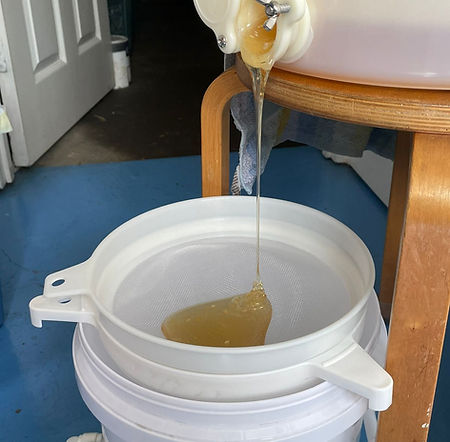
We had three crops of honey during the season totalling 43.3kg. What a year for honey and mainly from the original colony.
I had a happy problem, what do I do with all the fantastic honey?
The honey was very well received at the Buckhurst Hill Horticultural spring show which encouraged me to seek other local outlets for my Pilgrim’s Honey.
A ‘Honey for Sale’ sign has worked its magic and in early December I had sold out.

Mead
With some of the surplus honey I ventured into mead production and have two batches currently on the go. The first, an orange and lemon basic mead should be ready for Christmas with a mixed berry in the spring.
Polish
Adding the clean bees wax to coconut and walnut oils I made food grade wood polish.
Wax
As a bit of an after-thought I decided to do something with the wax collected from the cappings from the honey frames. Having washed the wax I then put it in a tray in the oven on a low heat and the melted wax floated to the surface, once it had cooled I had a cake of pure clean wax, amazing.
Candles
I bought some wax moulds and made some beeswax candles, amazing!
I now have a range of candles which includes two Camino candles, a St James’s cross candle and a scallop shell pattern candle.

Over- wintering
The hives although still active during October and into November soon form a tight cluster within the hives to get through the winter. The bees will require less attention but I will have to ensure that the bees don’t starve.
The colonies will be most at risk in the spring when the queen will begin laying again and more food will be required.
I have already noticed that the wonderful hive of 2025 has failed in early December. The queen, although healthy at the end of the season was in her third year and

Black Bees
In the hope of finding a more varroa resistant colony for the future I have ordered a Nuc of native black bees for the coming season. It would be fantastic if I could establish some strong colonies of our native black bee in Buckhurst Hill.
Pilgrimage
Beekeeping is a journey like most things in life and we just have to be open to learning and adapting to new challenges. It’s a day at a time and the joy is in the journey and not necessarily in reaching the given destination (the end of another season).
Beun Camino
